Wutoucao
Broken Rejected MateWolfsbane is the story’s most consequential anti-werewolf substance, moving between weapon, poison, diagnostic obstacle, and treatment burden. It does not merely injure the body: its presence exposes the hunters’ methods, tests the limits of Dysomnia strength, drives the pack’s medical response, and intensifies the moral conflict between revenge and restraint.
Definition and Function
Wolfsbane appears in several connected forms rather than as a single interchangeable threat. The hunters use it as an infusion in silver weaponry, and they also possess a particularly rare yellow variety that can be injected directly into the body. Its effects depend on the victim: the ordinary mixture contributes to Anthony Lowell’s severe condition, while yellow wolfsbane is powerful enough to cause agonizing pain in Sierra Langford without immediately killing her because she is a Dysomnia.
The substance therefore occupies an unstable boundary between medicine and violence. It is treated as something that must be removed from a victim’s system, yet its presence is also used to control bodies, prevent transformation, and make resistance physically difficult. Wolfsbane becomes dangerous not only through its toxicity but through the knowledge surrounding it: whoever can identify, acquire, administer, or neutralize it holds temporary power over werewolves.
Use in Hunter Attacks
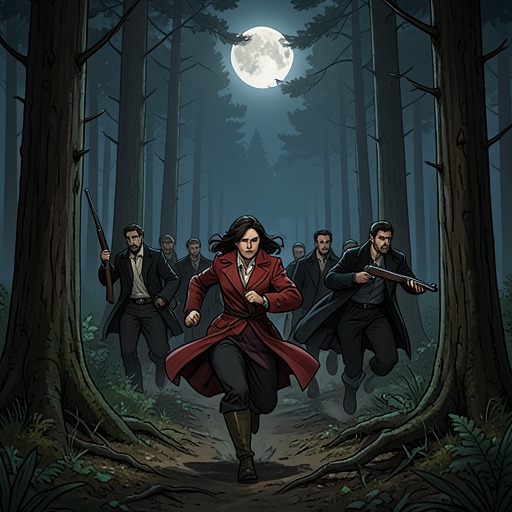
The clearest escalation occurs when a vengeful hunter attacks Sierra Langford and Alan Lowell. The hunter arrives in a white car, declares that he has changed his mind because his sister would want him to avenge her, and injects Sierra with liquid from a syringe concealed in a small black pouch. Sierra collapses immediately, clutching her neck. When Alan Lowell demands to know what has happened, the hunter identifies the substance as yellow wolfsbane and emphasizes its rarity, while also suggesting that Ronald Lowell may have been responsible for acquiring it.
The yellow poison changes the immediate stakes of the confrontation. Alan Lowell initially believes the hunter’s act may have killed his mate, but the hunter explains that the substance will not kill Sierra because she is a Dysomnia. That qualification does not make the attack harmless. Sierra is expected to endure agonizing pain, and the poison leaves her vulnerable while the conflict around her continues. Wolfsbane thus becomes a weapon designed not simply to destroy but to incapacitate, prolonging suffering and creating an opening for further violence.
The same poison later affects the confrontation with Ronald Lowell. When Ronald Lowell begins to glow and prepares to shift, Anthony Lowell produces a syringe and throws it to Drew, who advances on his father and injects him in the neck. Ronald Lowell falls before he can transform. The action reverses the hunters’ earlier tactic: the syringe is no longer solely an instrument of persecution but a means by which the threatened group prevents an escalation. Even so, the poison does not resolve the conflict cleanly. It leaves Ronald Lowell weakened at the moment when grief, guilt, and the consequences of his actions are already bearing down on him.
Medical Consequences and Treatment
Anthony Lowell’s injury establishes a different dimension of wolfsbane’s danger. Noah Collins explains that healing Anthony Lowell should ordinarily be easy for someone with his ability, but the sword used by the hunters was silver and had been infused with wolfsbane and another unidentified poison. The unknown component makes diagnosis and treatment more difficult, turning the wound into a problem of incomplete knowledge as well as physical damage. Healing power alone is insufficient when the healer cannot determine everything that has entered the victim’s body.
Sierra Langford’s poisoning eventually produces a similar medical aftermath on a larger scale. After the confrontation, the following weeks are largely spent at the pack hospital with Noah Collins while he removes the wolfsbane from her system. Recovery is therefore neither instantaneous nor symbolic: it requires sustained care, specialized ability, and time. The hospital becomes the place where the poison’s effects are slowly reversed, while the narrative’s surrounding grief prevents recovery from being mistaken for a return to normality.
Wolfsbane also prompts an unexpected act of knowledge. While holding Anthony Lowell’s hand, Sierra Langford feels a spark, experiences a vision, and hears her wolf speak a single word: “Lichen.” The vision supplies a possible clue to the substance or antidote needed for Anthony Lowell’s condition. The moment connects bodily poisoning with Sierra’s awakening relationship to her wolf, suggesting that survival depends on forms of perception the human part of her cannot access alone. The poison is therefore not only an obstacle; it is also the condition that brings hidden knowledge to the surface.
Victims, Persecution, and Classification
The repeated use of wolfsbane reflects the broader persecution of werewolves and especially Dysomnias. Sierra Langford’s father explains that Dysomnias have been hunted for centuries because their ancestors were believed to have become feral and killed other werewolves. Although the historical account is framed through fear of what Dysomnias might do, the attacks in the present show how that history continues materially: hunters carry specialized weapons, prepare poisoned blades, and obtain rare substances for use against a nearly extinct group.
This history makes wolfsbane part of a classification system that divides bodies into safe and dangerous categories. At Domina High, Sierra Langford knows that some students are supposedly werewolves like her, yet she believes they would never accept her. Her secrecy is supported by precautions intended to prevent anyone from discovering her identity. The same social boundary appears in the hunters’ treatment of her: she is not encountered as an individual first, but as a feared kind whose body is considered a potential threat.
The poison’s effects expose the instability of those categories. Sierra Langford survives yellow wolfsbane precisely because her Dysomnia body is different from that of an ordinary wolf, even though that difference is what makes her a target. The substance intended to prove or enforce her dangerous otherness instead demonstrates her endurance and the specificity of her biology. Later, the fact that she survives, grows in control, and is recognized as no longer a danger helps weaken the fear surrounding Dysomnias.
Narrative Significance
Wolfsbane repeatedly converts conflict into a question of responsibility. Hunters use it to avenge deaths and incapacitate enemies; pack members use it to stop Ronald Lowell from shifting; healers struggle to identify and remove it; and Sierra Langford must decide how to use her own power while Alan Lowell lies within reach of revenge. In this pattern, poison is never merely a technical detail. It is the material trace of choices made under fear, grief, and inherited violence.
Its most important contrast is between injection and removal. The hunter’s syringe produces immediate collapse and helplessness, while Noah Collins’s prolonged work at the pack hospital gradually restores Sierra Langford’s clarity. The first act is secretive and punitive; the second is communal and restorative. The difference does not erase the damage, but it establishes two competing systems of power: control through contamination and protection through knowledge.
By the end of the documented aftermath, wolfsbane has not vanished from the story’s consequences. Sierra Langford is still recovering while the pack conducts a traditional burial for Andrew Lowell and prepares Ronald Lowell’s trial. The poison links these apparently separate outcomes: it helped incapacitate Sierra Langford, later weakened Ronald Lowell, and left the pack to manage the physical and emotional wreckage. Wolfsbane’s lasting significance lies in that chain. It begins as a hunter’s instrument, becomes a test of Dysomnia survival, and ends as evidence that the body remembers political violence long after the weapon has been put away.